About
About
Solution
SPS
Detect Grid Overload Risks in Real Time and Implement Rapid Load Shedding to Prevent Fault Escalation and Cascading Failures.
Market Overview & Pain Points
Market Overview & Pain Points
With the large-scale grid integration of energy resources such as solar PV, wind power, and energy storage, power system operation and load management are becoming increasingly complex. Transmission and distribution lines, as well as grid connection points, may face capacity constraints and overload risks. When power generation or line current exceeds permissible system limits, failure to implement timely protection and load shedding measures may trigger protection devices, cause line tripping, or even escalate the impact of grid incidents.
For large-scale renewable energy projects and grid-connected facilities, in addition to complying with utility grid connection and protection requirements, establishing a fast and reliable protection and control mechanism is essential. When abnormalities occur, the mechanism must assess system conditions in real time and execute power curtailment, load shedding, or tripping according to predefined protection logic.
Therefore, integrating real-time monitoring, protection logic, and rapid load shedding control has become essential for large-scale grid-connected facilities to implement timely protective measures during overload conditions, mitigate the risk of incident escalation, maintain safe system operation, and ensure compliance with grid connection requirements.

Applicable Object
Applicable Object
Power Utility Dispatch and Substation Maintenance Departments

Renewable Energy Developers

Renewable Energy O&M Service Providers

Power System Planning & Engineering Organizations

Large Industrial Consumers & Industrial Parks

Pain Points
Pain Points
- Increasingly Stringent Grid Connection Protection and Acceptance Requirements: Renewable energy projects and large-scale grid-connected facilities must comply with Taipower’s protection requirements. Failure to meet requirements for protection logic, operating conditions, or system design may increase risks associated with grid connection testing, system acceptance, and subsequent operation.
- Need for Rapid and Accurate Overload Detection: When feeder current exceeds predefined thresholds, failure to accurately determine the severity and duration of an overload may result in delayed or unintended load shedding, affecting normal site operation and the effectiveness of protection mechanisms.
- Increased Equipment and System Risks Due to Line Overloads: When power lines or grid connection points experience sustained overloads, failure to reduce loads promptly may result in equipment tripping, damage, or incident escalation, increasing operational and equipment safety risks.
- Limited Real-Time Visibility into System and Protection Equipment Status: Without real-time monitoring of line current, voltage, switchgear status, and protection equipment information, O&M personnel may struggle to promptly identify abnormalities and protection operations, increasing the time required for event tracking and fault resolution.
Our Solution
Our Solution
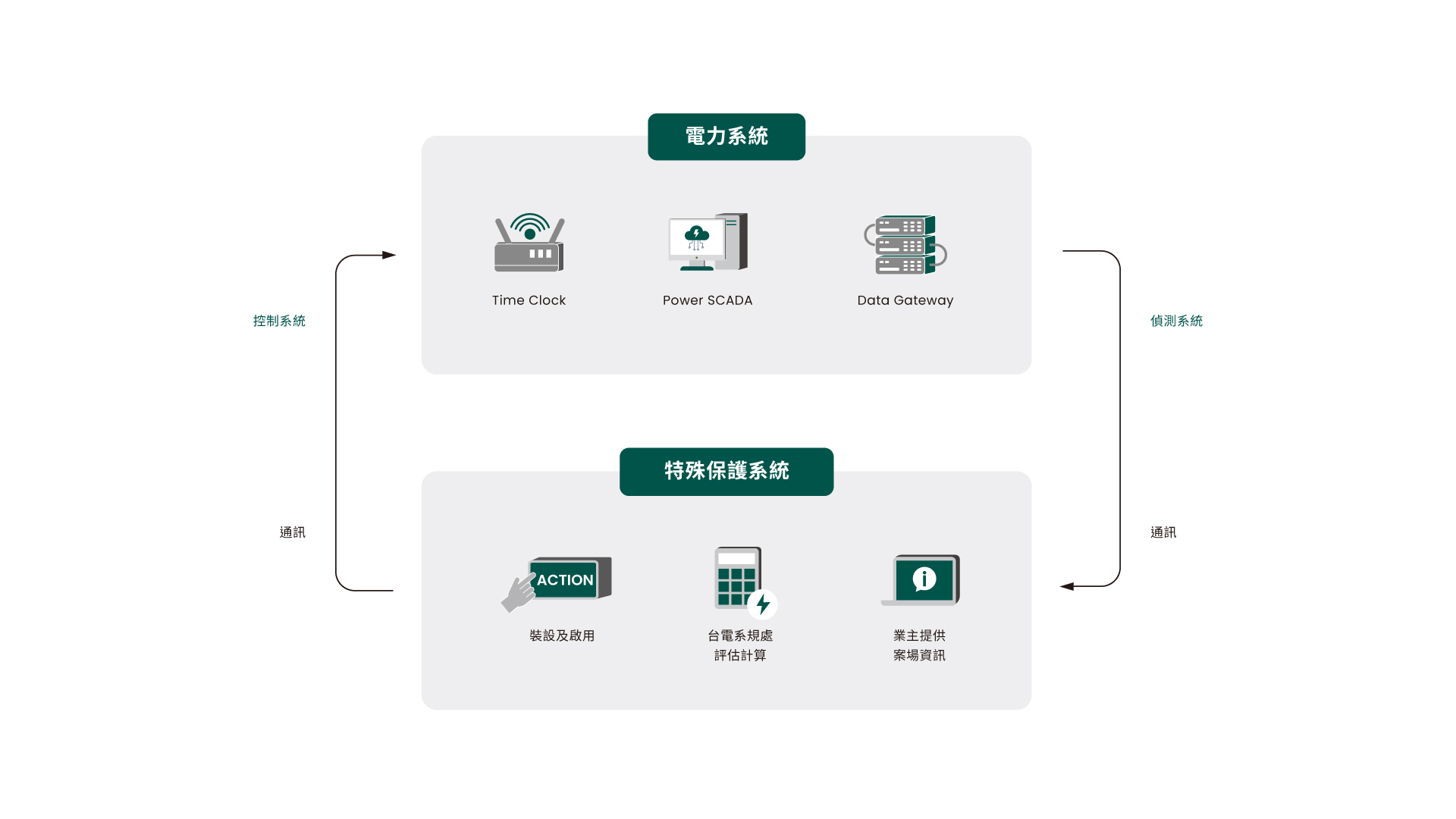
The 50+2 Special Protection System (SPS) is a grid protection and rapid load shedding solution specifically designed for renewable energy, energy storage, and large-scale grid-connected facilities. When overload risks arise on transmission lines, distribution feeders, or grid connection points, the system executes power curtailment, load shedding, or tripping control according to predefined protection logic, mitigating the risk of incident escalation and ensuring stable grid operation.
Intelligent Cloud Plus (ICP) provides end-to-end services covering system planning, protection logic design, equipment integration, on-site testing, system acceptance, and project delivery, with seamless integration of SCADA, IEDs, RTUs, and IEC 61850-based smart substation architectures.
The solution helps solar PV, wind power, energy storage, and various grid-connected facilities comply with Taipower’s protection requirements, reduce the risks of overload-induced tripping, cascading failures, and system acceptance issues, while enhancing power supply security and grid resilience.
Features
Features
● Compliance with Taipower’s 50+2 Protection Requirements: Designed in accordance with Taipower’s renewable energy grid connection protection requirements, the system automatically executes load shedding when feeder current exceeds a predefined threshold for a specified duration, ensuring compliance with grid connection requirements.
● High-Speed and Precise Load Shedding Control: Combines current thresholds and time-delay logic to accurately identify overload conditions and rapidly execute load shedding, effectively preventing unintended protection operations and unnecessary downtime.
● Enhanced Grid Stability and Equipment Protection: Immediately reduces line loading when system overloads or abnormalities occur, preventing incident escalation and equipment damage while enhancing power supply reliability and grid resilience.
● Real-Time Monitoring and Event Alarms: Provides real-time monitoring of line current, voltage, switchgear status, and protection equipment operating conditions, automatically sending alarm notifications when abnormalities are detected.
System Architecture
System Architecture