About
About
Solution
Smart Grid & Grid Resilience Solutions
Built on the IEC 61850 international standard, integrating monitoring, operations and maintenance, and cybersecurity applications to enhance grid resilience.
Market Overview & Pain Points
Market Overview & Pain Points
With the rapid growth of renewable energy, energy storage systems, and large-scale power-consuming facilities, power systems are evolving from traditional one-way power supply models toward next-generation grids that support diversified energy integration and bidirectional power flow and dispatch. As the energy landscape transforms and grid operations become increasingly complex, grid management requires greater real-time visibility, intelligent analytics, and operational flexibility to meet the evolving needs of future smart grids.
As IEC 61850 and digital power system technologies continue to be deployed across substations and large-scale energy facilities, equipment standardization, information digitalization, and system interoperability have become essential foundations of modern smart grids. The next challenge lies in effectively integrating and utilizing existing operational and asset data to connect applications such as centralized monitoring, remote management, fault analysis, intelligent operations and maintenance, cybersecurity protection, and energy management. This integration enables digital infrastructure investments to be transformed into tangible operational and management benefits.
As a result, the development of smart grids is advancing beyond simple equipment digitalization toward intelligent operations. Through the integration of information across multiple systems, devices, and sites, organizations can continuously enhance grid management capabilities and enable more intelligent, data-driven operations and maintenance.

Applicable Object
Applicable Object

Utilities & Transmission / Distribution Operators

Renewable Energy Developers
Energy Storage and Ancillary Service Providers

Large Industrial Users and Industrial Parks

EPC Contractors / System Integrators
Pain Points
Pain Points
- Data has been digitized, but remains siloed across multiple systems: Equipment, alarm, and operational data are often distributed among different systems. Without deeper integration, the benefits of cross-site visibility and centralized management remain limited.
- Event data continues to accumulate, but is not transformed into actionable insights: SOE records, event logs, IED data, and equipment status information are scattered across multiple systems. Without effective integration, fault investigation, anomaly identification, and event analysis still rely heavily on manual expertise and experience.
- Equipment is connected, yet O&M remains highly labor-dependent: Equipment maintenance still relies primarily on scheduled inspections and reactive maintenance after failures occur. Equipment health and abnormality trends are not yet fully utilized, limiting the transition toward condition-based and predictive maintenance.
- Energy data is fragmented, making multi-site operations difficult to manage: Data from substations, solar power plants, wind farms, and energy storage systems are dispersed across different sites and systems, increasing the complexity of centralized energy visibility and cross-site operational management.
Our Solution
Our Solution
Extending Smart Grid Applications from a Digital Foundation
Intelligent Cloud Plus (ICP) builds on the IEC 61850 international standard as the foundation for digitalization, integrating power equipment, communication networks, Power SCADA, data management, and OT cybersecurity. This integrated architecture enables centralized monitoring, remote management, incident analysis, intelligent O&M, and energy management.
Based on site-specific requirements, extended solutions such as SAS Manager, IED Manager, SAMS, and SPS can be deployed to provide one-stop smart grid integration services—from planning and design to system implementation, operation, maintenance, and future expansion.
By transforming equipment and operational data into business value, ICP helps customers advance toward more centralized, remote, and intelligent operations.
Extending Smart Grid Applications from a Digital Foundation
Features
Features
From Device Interconnectivity to Intelligent Operations
● IEC 61850 Standardized Integration: Establishes a standardized IEC 61850 communication architecture that integrates IEDs (Intelligent Electronic Devices), protection relays, SCADA, and upper-level systems, enabling seamless interoperability among devices and efficient data exchange.
● Fully Digital Substation Communications: Supports high-speed communication mechanisms such as GOOSE and Sampled Values (SV) to meet the requirements of protection and control, switch interlocking, dispatching strategies, and fully digital measurement. This significantly reduces hardwiring requirements and lowers installation and engineering costs.
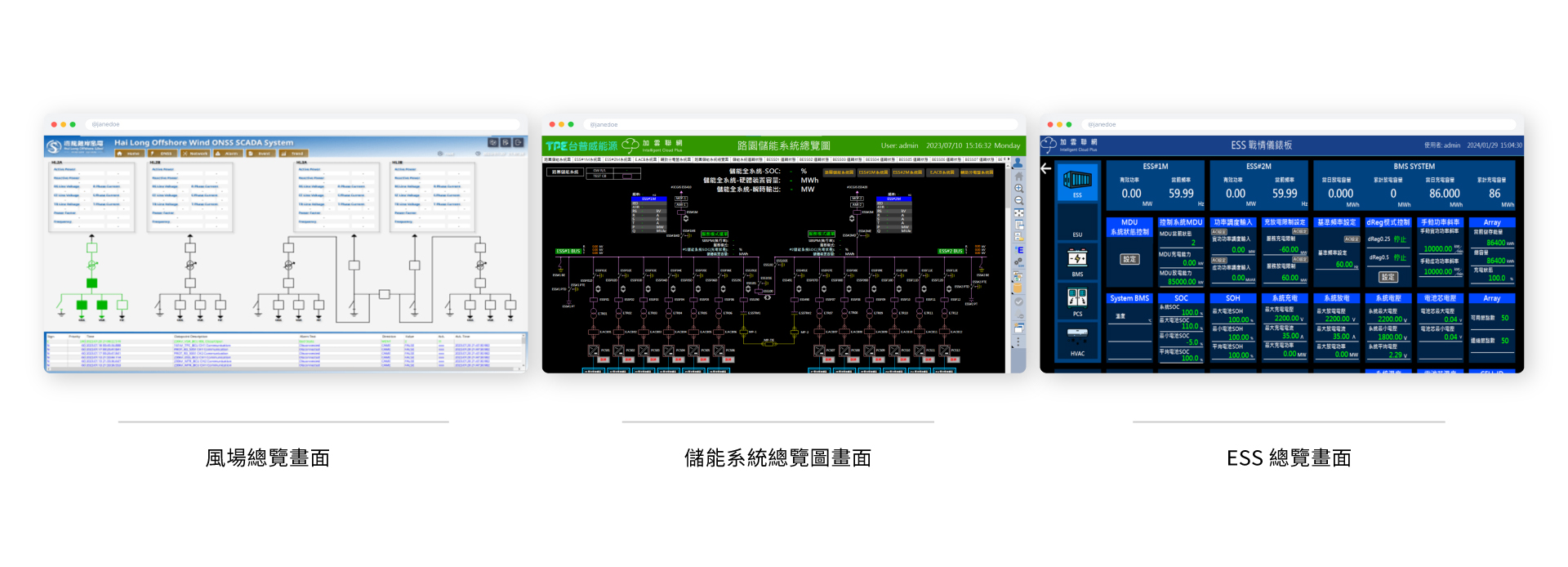
● Intelligent Monitoring and Cross-Site Integration: Integrates Power SCADA, IEDs, RTUs, protection relays, and dispatch center systems (ADCC/CDCC/DDCC/DREAMS) to centralize equipment monitoring, power data, event alarms, and operational information. It further connects substations, renewable energy facilities, and energy storage sites, enabling centralized multi-site monitoring, remote management, and integrated energy information management.
● OT Cybersecurity and Remote Management: By adopting a layered IT/OT architecture, network segmentation, the principle of least privilege, and cybersecurity monitoring mechanisms, the solution incorporates OT cybersecurity as an integral part of the smart grid framework. As equipment connectivity, centralized monitoring, and remote operations continue to expand, it enables secure, reliable, and resilient remote management and intelligent grid applications.
● Incident Analysis and Intelligent O&M: Integrates equipment history, Sequence of Events (SOE), event records, alarms, IED information, equipment status, and health indicators to support consolidated incident information, fault localization, and event analysis. It also enables a progressive transition from Time-Based Maintenance (TBM) to Condition-Based Maintenance (CBM), anomaly early warning, predictive maintenance, and equipment lifecycle management.
From Device Interconnectivity to Intelligent Operations
System Architecture
System Architecture
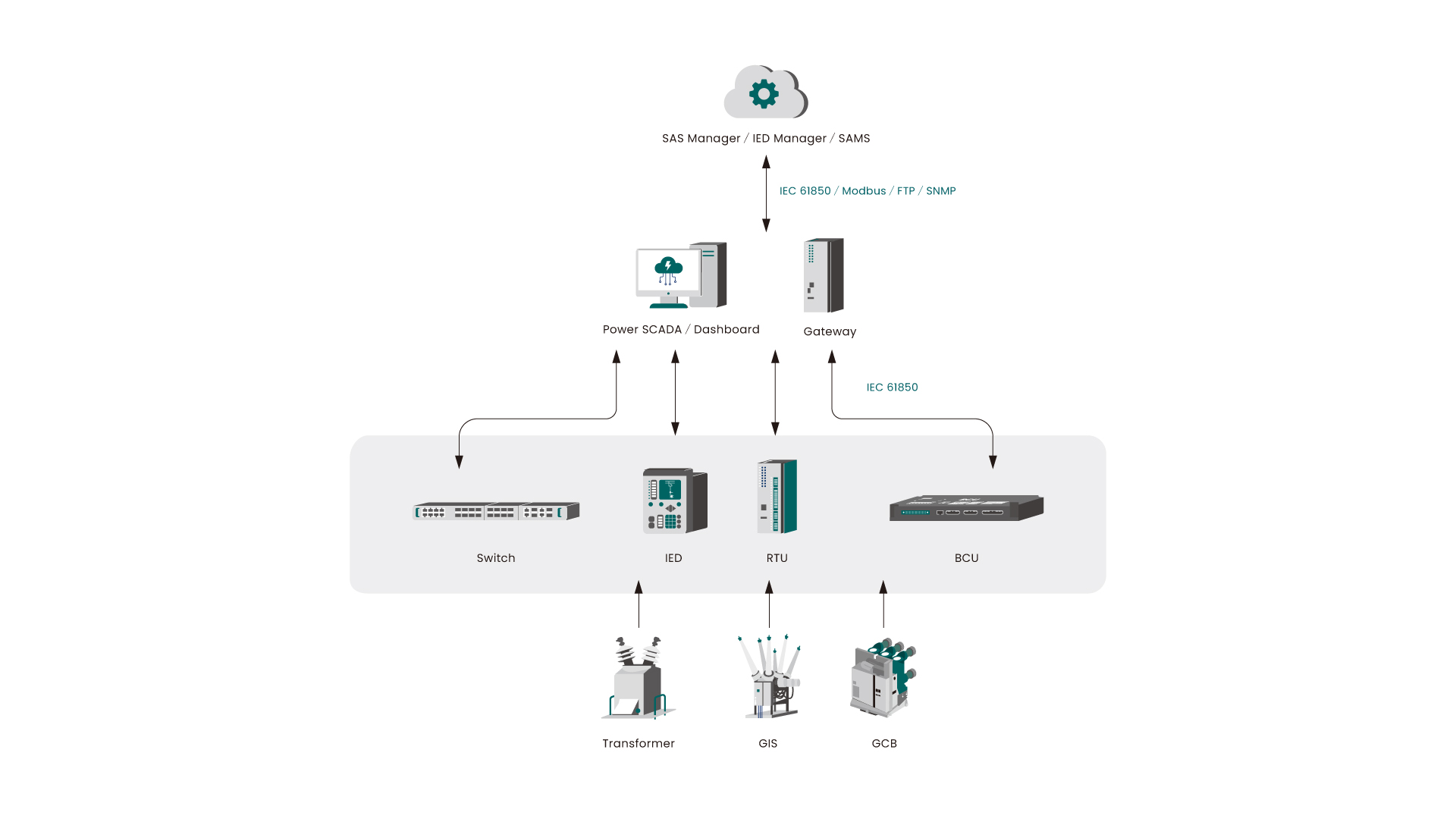
System Interface
System Interface